Fri Sep 05 2025
Late Bloomer or Autism? How to Tell the Difference in Your Child's Development
Neurologically, a child’s brain grows tremendously in the first five years of life. Speech, emotions, social skills, it all begins during this period of time. It is what experts refer to as the “critical window” of development as their brains are busy wiring and tuning connections based on everyday moments and loving attention.
Every parent hopes their child reaches milestones on time like crawling, talking, and making friends.
But what if your child takes longer, are they called a late bloomer kid? Or something more, like autism? These questions are hard and can hurt your heart. You just want the best. Let’s get started.
Understanding Developmental Delays and What “Late Bloomers” Are
Some kids take a little more time to grow certain skills. This is called developmental delay. A child might walk at 18 months instead of 12 months. That can be okay.
Here’s what being a late bloomer might look like:
- They learn to talk or walk a little later than others their age
- They are curious and observant, just not very vocal
- They eventually catch up on their own, without therapy or help
Developmental Milestones by Age (Typical)
6 months: Smiles, makes sounds — Laughs, turns to voices
12 months: Says “mama” or “dada” — Waves bye-bye, crawls
18 months: Walks, points, says words — Imitates you, shows interest in others
24 months: Says 2-word phrases like “more juice” — Plays with toys properly
36 months: Talks in simple sentences — Pretend play, shows feelings
If your child is a few months behind, that’s okay. Some grow slowly but beautifully.
But What If It’s Autism?
Autism is a neurodevelopmental condition that means the brain works differently from the start.
Kids with autism may not grow out of their delays without support. The signs are often visible by age 2, though some show earlier or later.
What Is Autism?
- It affects social skills, communication, and behavior
- Called a “spectrum” because it looks different/unique in every child
- Some kids don’t speak while some speak a lot but can’t understand emotions
- Some kids love hugs and others don’t like being touched at all
Late Bloomer or Autism? Key Differences
Here’s a helpful comparison to understand if it’s a late bloomer or autism.
Comparison Table: Late Bloomer vs. Autism

Early Signs of Autism vs Normal Developmental Delays
Let’s break it down by signs and what to look for.
1. Communication
Late Bloomer
- May say words late but tries to imitate sounds
- Can point or use gestures to show needs
Autism
- May not try to communicate, even with gestures
- Repeats words (echolalia) without meaning
- Doesn’t babble by 12 months
2. Social Interaction
Late Bloomer
- Enjoys being held, played with, smiled at
- Learns to engage with others over time
Autism
- Generally tries to stay alone, doesn’t talk or make eye contact
- Doesn’t respond to facial expressions or social games
Play Behavior
Late Bloomer
- Starts pretend play a little late
- May prefer toys over people at times
Autism
- Lines up toys, spins wheels, or flaps hands repeatedly
- Rarely shows pretend play like feeding a doll
Late Bloomer Red Flags by Age
It’s natural to feel worried if your child isn’t speaking by the “right” age. Some children are simply late bloomers and naturally catch up. But if your child doesn’t make eye contact, doesn’t answer when called by name, or appears uninterested in communicating, it’s important to speak with a doctor.
12 Months
Okay to Wait If
- No clear words yet
- But baby babbles, makes eye contact, uses gestures like waving or pointing
Talk to a Doctor If
- No babbling at all
- Doesn’t respond to name
- Doesn’t point or show interest in people or things
18 Months
Okay to Wait If
- Says 5–10 words
- Tries to imitate sounds
- Uses gestures to express needs
Talk to a Doctor If
- Says no words
- Doesn’t play pretend
- Doesn’t copy adults or show interest in play
24 Months
Okay to Wait If
- Has around 50 words
- Begins to use 2-word phrases like “Want chocolate”
Talk to a Doctor If
- Says fewer than 50 words
- Doesn’t combine words
- Avoids eye contact or doesn’t follow instructions
36 Months
Okay to Wait If
- Speech is simple and may not be perfect
- Talks in 3-word sentences
- Tries to play with others
Talk to a Doctor If
- Unable to speak properly
- Doesn’t show interest in surroundings
- Has rigid routines or strong resistance to change
If several of these happen together, talk to your child’s pediatrician.
How You Can Support Your Child Right Now
Whether your child is autistic or a late bloomer, your love makes the biggest difference. They feel your care. They know when you’re trying. Here’s how you can help every day.
Speak to Them Often
- Describe what you’re doing
- Label emotions like “You look happy” or “That scared you”
Play Together
- Follow their lead
- Join their games, even if they’re quiet or unusual
Use Visuals
- Pictures can help explain what’s next, e.g., brushing teeth, bedtime
- Helps all kids, especially those with autism
Be Patient
- Repeat things gently
- Give extra time to respond
Step-by-Step Approaches for Developmental Delays in Toddlers
We’ll walk you through each step. So you prepare yourself and your child and know exactly what to expect.
1. Noticing the Delay
It starts when you or your child’s doctor notices something is a little behind. Maybe your child isn’t talking like others their age. Or maybe they don’t play with other children much. This is when parents often ask, “Should I wait, or get help now?”
2. Getting a Developmental Screening
Your doctor may suggest a developmental screening. This is a short test to check how your child is growing and learning. It covers speech, movement, social interaction, and play.
3. Getting a Full Evaluation
An expert, like a child psychologist or developmental pediatrician, will spend time with your child. They’ll play, talk, and observe. You’ll also answer questions about your child’s behavior and milestones. The goal is to understand if it’s just a delay or something else like autism.
4. Making a Therapy Plan
If your child is a late bloomer, the team may still suggest therapy. This doesn’t mean anything is “wrong.” It just means extra help can support your child’s growth. They may recommend speech therapy, occupational therapy, or play-based early intervention.
5. Starting Therapy
Therapy is often once or twice a week. It can take place at a clinic, school, or even right at home. The sessions are focused on simple goals. It can include helping your child use more words or ask for help. Therapy is like guided play. Your child may not even know they’re learning.
6. Getting Involved as a Parent
You are part of the therapy too. Therapists will show you small things to do at home, like how to encourage speech during snack time or handle tantrums with calm words. The more support at home, the more your child grows.
7. Checking Progress Over Time
Every few months, your therapist or doctor will check how things are going.If more support is needed, the team will adjust the plan.
Conclusion
creates neural connections at the rate of over one million per second. If your child is a late bloomer, or has autism, they all deserve love, respect and care. They are not “behind”, they are progressing in their own way.If you’re unsure, ask. Speak to your doctor. Get a developmental checkup because no matter what, early help brings brighter days. And millions of children have grown, and bloomed in their own beautiful ways.
Late Talker vs Speech and Language Delay
Children grow at different paces. It happens generally when it comes to talking or speech related concerns. Some children begin to talk quite early. Some really take time to speak. But, you must be wondering if your child is simply a “late talker”? Or is it a more serious issue such as a speech or language delay?
At Continuakids, centre for child development with a focus on early intervention. Indeed, every child grows at a different pace. But, a speech and language delay may also need treatment.
Let’s explore the difference between a late talker and a child with a speech/language delay. We will also look at what can cause speech delay, what the signs are, and the best possible way to treat speech language delay in a late talker toddler.
What is a Late Talker?
A late talker toddler takes time to communicate or even say a single sentence properly. These children are verbal, have good comprehension of language, attentive to and responsive to instructions, social interactions but are less talkative in nature.
Characteristics of Late Talkers
What is Speech and Language Delay?
Speech and language delay can be defined as a child’s slow speed to achieve the typical developments in speech, comprehension, or language use.
In contrast to late talkers, these children might also have difficulties with word comprehension, sentence building, or expressing their ideas. This delay is known as speech language delay, and can be treated with the right speech therapy plans.
Key Differences
| Feature | Late Talker | Speech & Language Delay |
|---|---|---|
| Understanding | Normal | May be limited |
| Social interaction | Normal | May be affected |
| Play skills | Age-appropriate | May be delayed |
| Catching up by age 3 | Often | Not always |
| May need therapy | Not always | Often recommended |
Early Signs/Symptoms of Speech Delay Every Parent Should Know
There are many causes of speech delay. And sometimes there is not an identifiable cause. But in some cases it is associated with somatic, neurological or developmental problems.
Common Causes of Speech Delay
1. Hearing Problems
- A child who cannot hear will not learn how to speak
- Sound and word can be affected by ear infections, fluid, or hearing loss
- Children may not respond to their name
- They might not react to loud noises
- Speech may sound unclear or limited
2. Oral-Motor Issues
- Problems with the movement of the mouth, tongue, or jaw needed for speech
- Children may drool frequently
- They may have trouble chewing or blowing
- Speech may sound slurred or weak
3. Developmental Disorders
- Seen when other conditions, such as autism spectrum disorder (ASD), Down syndrome or intellectual disability, are diagnosed
- May have delayed milestones in multiple areas
- Limited eye contact or social response
- Repetitive behaviors or difficulty in learning words
4. Neurological Problems
- Brain injuries, cerebral palsy, or genetic conditions can lead to speech delay
- Muscle weakness or coordination issues may be present
- Speech may develop very slowly
5. Environmental Factors
- Limited interaction with caregivers
- Too much screen time
- Growing up in a bilingual or multilingual environment, where people speak different languages at the same time
Age-Wise Signs of Speech Delay in Children
Early detection is key. Parents should start talking with the child regularly, asking him/her about the day or how he/she is feeling. While communicating, note the signs if he/she is taking time to speak or to process the sentences.
By Age Milestones
| Age | Red Flags |
|---|---|
| 12 months | No babbling or gestures like waving |
| 18 months | No words, doesn’t respond to names |
| 36 months | Fewer than 50 words, not combining words |
| 48 months | Unclear speech, hard to understand even for family |
At-Home Speech Therapy Activities for Parents to Support Your Child
We believe in early intervention at all times. Parents can boost their self-confidence.
Simple Ways to Encourage Speech
- Talk often: Describe what you are doing, seeing, or touching
- Read books: Start with picture books. Let the child name what they see
- Sing rhymes: Nursery rhymes like “Twinkle twinkle,” “Baa baa Black sheep,” and teach new words
- Play together: Use toys, pretend play, and role play
- Give time to respond: Don’t rush the child. Wait for them to speak
These activities build vocabulary, improve understanding, and encourage expression.
Does Your Child Need Speech Therapy? Know What to Expect
Not all children who talk late need therapy. But if there are delays in both speech and understanding, or if the child seems frustrated trying to communicate, professional help is advised.
At Continua Kids, a multi-disciplinary team evaluates:
- Hearing and oral health
- Developmental milestones
- Play and social skills
- Speech and language abilities
The team may use tools like:
- VB-MAPP (Verbal Behavior Milestones Assessment and Placement Program)
- ABLLS-R (Assessment of Basic Language and Learning Skills)
- Language sampling and observation
What Happens in Speech Therapy?
- By using play-based learning, therapists work with the children
- They model correct speech and give chances to repeat sounds or words
- Visuals, gestures, and activities may be used to improve understanding
- Parents and therapist counselling sessions are organized on how to support communication at home
Therapy is usually short and regular, for example 30–45 minutes, 2–3 times a week. It may go on for several months depending on progress.
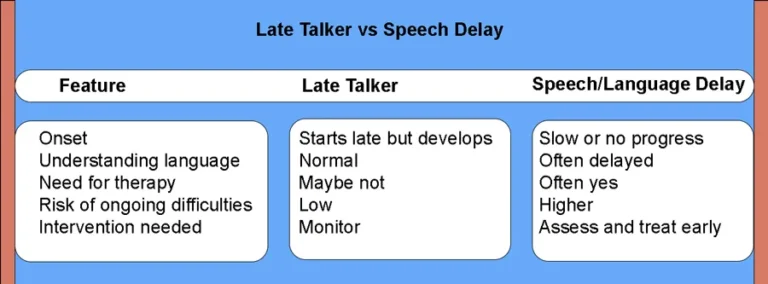
Late Talker vs Speech Delay
| Feature | Late Talker | Speech/Language Delay |
|---|---|---|
| Onset | Starts late but develops | Slow or no progress |
| Understanding language | Normal | Often delayed |
| Need for therapy | Maybe not | Often yes |
| Risk of ongoing difficulties | Low | Higher |
| Intervention needed | Monitor | Assess and treat early |
How Is Speech Delay Diagnosed?
It involves structured evaluation by trained professionals.
Steps in Diagnosis
1. Developmental History
- Questions about pregnancy, birth, and early milestones
- Family history of delays or disorders
2. Hearing Assessment
- Rule out hearing loss as a cause
- Conducted using audiometry or ENT consultation
3. Speech-Language Evaluation
- Done by a certified Speech-Language Pathologist (SLP)
- Tests involve Receptive-Expressive Emergent Language Scale (REEL) or Preschool Language Scale (PLS)
4. Observation and Play Assessment
- Evaluates how the child interacts, follows directions, or uses gestures
What Happens If Speech Delay Is Left Untreated?
Children can bear long-term consequences if speech delay is left untreated.
Potential Long-Term Effects
1. Academic struggles
- Difficulty with reading, writing, and spelling
- Trouble following instructions in school
2. Social challenges
- Difficulty making friends
- Frustration in group settings
3. Emotional impact
- Low self-esteem
- Withdrawal or behavioural problems
4. Delayed overall development
- Cognitive delays
- Limited ability to express thoughts clearly
Early treatment not only improves communication but also boosts confidence, learning, and relationships.
Conclusion
Not every child talks at the same time. Some can be slower than others. If your child is struggling to meet speech milestones or find it difficult to do so, ask for help.Continua Kids offers a nurturing, clinical environment with expert speech therapists, pediatricians, and psychologists working together as one team to achieve desired results.